
Salt Lake County Warrant Searches
Utah BCI's statewide warrant search is the first stop for a Salt Lake County warrant search. From there, work toward the issuing court. XChange helps you locate public docket information, and the Sheriff links to both routes. Search your own name. A relative's matter needs authorization first. Before contacting a clerk, confirm the court name on the result, since a clear screen may still leave a restricted warrant record unlisted and unstated. If payment or a hearing is involved, ask the issuing court. It can explain its current instruction and what it needs from you. A county records request is no substitute for a judicial file.
- Open the BCI search from the official Utah BCI page.
- Use the name fields shown by the official explanation; do not assume a date-of-birth or county filter.
- Record the court or case identifier shown, if any.
- Use XChange for public case information or call the named court.
- Ask the clerk what confirms status and what procedure applies.
Salt Lake County Warrant Search Starts With BCI
Utah keeps its warrants in one statewide file. The Bureau of Criminal Identification runs it, and the official BCI warrant page opens the Utah Statewide Warrants search. It spans state court activity, so a Salt Lake County bench warrant, arrest warrant, or traffic warrant tied to a felony, misdemeanor, or infraction case can all sit in the same system. The sheriff's office points people to BCI rather than hosting a county-only roster, so that is where a warrant lookup begins. One caution applies. The live endpoint returns a 403 error at times, which blocks access and leaves the fields and result layout unseen. BCI's own explanation covers access, and the issuing court remains the place for case-level instructions once a warrant check turns up a hit.
What a Warrant Search Asks For
A Utah sheriff's official explanation shows what the search form asks for. Expect a last-name field, a first-name field, an optional middle initial, and a Search control. Last name is marked required. Nothing there promises birth-date, county, warrant-type, or date filters, so do not count on them. A middle initial will not always split a common-name match in Salt Lake County either. Two people can share one name in a county this size. Enter only what the page requests.
| Field shown by an official explanation | What research confirms |
|---|---|
| Last name | Shown and marked required on the proxy explanation |
| First name | Shown; required status was not independently confirmed |
| Middle initial | Shown as optional on the proxy explanation |
| Search button | Shown; exact live layout was not verified |
| County, DOB, type, or date filter | Not verified; do not promise these options |
Salt Lake County Search Fields Verified by Official Sources
The field pattern above has an official Utah source. It comes from a county sheriff's explanation, though, so it does not prove every county or the state site uses the same live layout for a Salt Lake County warrant check. Enter only what the page asks for. Keep your result private. Never send personal details to an unsolicited caller. If the controls change, follow the current BCI instructions rather than an old page view or a third-party copy. The official page is the only version worth trusting.
Salt Lake County Warrant Search Results
No fixed columns shape the public result screen. BCI training materials describe agency-side data such as a warrant date, an offense code, and an agency control identifier. Those items may never reach the public view. Treat them as background, not a promise. When a Salt Lake County match appears, take the court case number and the court name to the clerk and ask for the public case record.
| Name match | Check the court and case context before deciding a result refers to the right file. |
|---|---|
| Warrant date | A system field in training material; it may differ from a citation date. |
| Offense code | Ask the court for its plain-language case description. |
| Issuing court | Use it to reach the clerk who can explain case status. |
| Bond or release terms | Confirm directly; no universal Salt Lake County amount was found. |
Salt Lake County Warrant Results Need XChange Case Context
Utah Courts' XChange supplies public case information for district and justice courts. It can tie a warrant match to an actual case. But it is not the statewide warrant file, and it does not show every record. Sealed and expunged material stays out of reach. So do juvenile records. Coverage notes track court history for Salt Lake City, West Jordan, Murray, Sandy, and West Valley. Public terminals at the courthouse offer another route in. A party account tool such as MyCourtCase carries identity requirements and cannot replace a public name search. Review Utah Courts' XChange access rules before treating a missing docket as a final answer.
Salt Lake County Warrants: Who Holds What
Each issuing court controls its own case record. In Salt Lake County, Third District Court handles felony and Class A misdemeanor matters, while local justice courts keep their own city and county cases. The Sheriff links to BCI. It also runs a Warrants & Extraditions function, though it lists no direct public warrant line and no separate county roster.
| Need | Official route | Local detail |
|---|---|---|
| Statewide warrant search | Utah BCI | Public entry point for the Statewide Warrants File |
| District case | Third District clerk | Criminal contact: 801-238-7321 |
| County citation or lower-level case | Salt Lake County Justice Court | 385-468-8200 |
| City citation | Issuing city justice court | Contact varies by city |
Salt Lake County Court Records and GRAMA Requests Are Separate
Salt Lake County keeps administrative records in its NextRequest portal. Search and Make Request controls sit there, along with a GRAMA explanation. The county posts no warrant-specific fee. A judicial file is a different matter. That belongs with the court clerk under Utah's court-record rules. When you write a request, name the agency, the record type, the case number if known, and a date range, and ask for the public portions if some material is restricted. Use the portal as a locator for county records, never as a court case search.
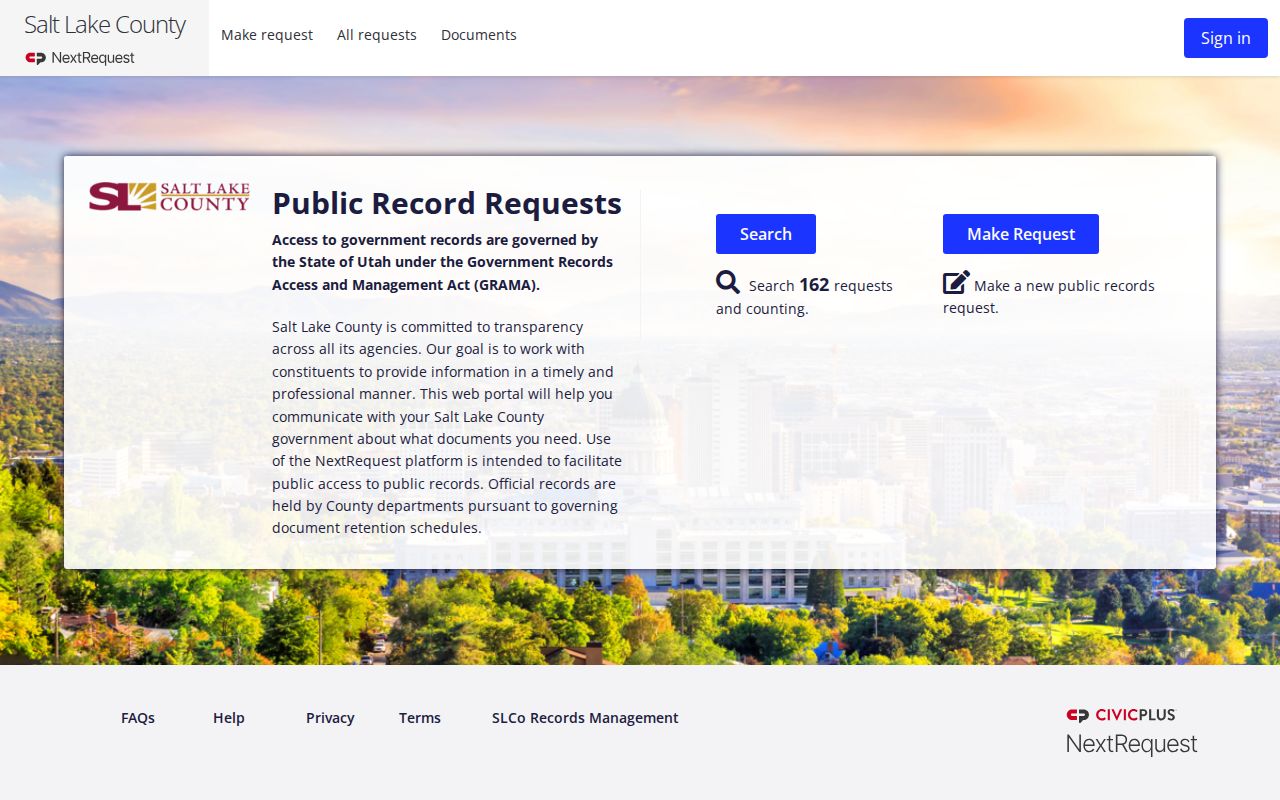
Salt Lake County's portal handles administrative records. Open Salt Lake County's official GRAMA portal for county-held files, while a court clerk stays your contact for judicial case information.
Which Salt Lake County Warrants Stay Restricted
GRAMA covers county administrative records. In Salt Lake County, judicial files answer to Utah's court rules instead. Rule 4-202.02 generally makes arrest-warrant records public, though a court may restrict access before service, and Rule 40 with its unsealing provisions governs search-warrant material. Restricted categories stay withheld. Juvenile, sealed, expunged, personal, and protected law-enforcement information can be withheld. A written request may still be reviewed or denied under the court process.
Access rules:
GRAMA covers Utah public records held by county agencies.
Rule 4-202.04 describes written court-record requests and review.
XChange omits sealed, expunged, juvenile, and other restricted matters.
Salt Lake County Warrant Lookup Limits Are Part of the Result
Salt Lake County warrant lookup results have limits worth knowing. BCI's manual flags one of them plainly: a single person can match more than one warrant or court, since courts feed their entries in through electronic transfers. So a hit is a lead, not a full court history. Read it with care. If a result looks wrong, jot down the court name and ask its clerk to verify the case number. Come up empty? Then contact the court you believe issued the warrant, because a blank search does not prove none exists. For the question of a published list, the active-warrant page explains why Salt Lake County posts no separate roster.