
Salt Lake County Warrant Checks
Utah's Bureau of Criminal Identification runs a free Statewide Warrants search. Start there. The Salt Lake County Sheriff sends people to that statewide file and posts no county roster of its own. Search your own name, or a relative's matter if you are authorized, and note the court or agency on any match. A name alone can mislead. Use XChange or the issuing court clerk. Ask that court for public case details and the next required step before you pay, appear, or file anything.
- Open the BCI warrant page from an official Utah government site.
- Search with the name fields shown on the official explanation; do not assume a birth-date or county filter is available.
- Write down the court name and case information shown, if any.
- Check XChange or contact that court for the case-level record.
- Ask the issuing court about appearance, payment, bond, or recall steps before acting.
Utah’s Statewide File Is Salt Lake County’s Starting Point
Utah's Statewide Warrants File gathers warrant activity from courts across the state through court-system transfers. The Sheriff's site links to BCI, not to a second Salt Lake County search. That makes BCI the entry point. If the portal will not load, use the court directory or the Salt Lake County Criminal Justice Services warrant link. Then verify with the court that controls the case. Courts keep their own warrant records current. A statewide match names a court. It does not tell you whether a payment, hearing, or recall has been recorded. Only the clerk of that court can confirm the status of the case. Call before you act on the result.
Warrants in Salt Lake County: The Main Types
The issuing court matters most in any Salt Lake County warrant record. Several court processes can create the entry. A citation case can turn into a bench-warrant matter after a missed required appearance. Arrest warrants follow a probable-cause process. Search warrants cover a search of a person, place, or property, and their public access rules differ. Utah's own materials do not use "capias pro fine" as the local term, so the court's documented wording governs.
| Record type | Local context | Where to confirm |
|---|---|---|
| Arrest warrant | Probable-cause process for a criminal case | Issuing justice or district court |
| Bench warrant | May follow a missed citation or court obligation | Court that set the date or condition |
| Traffic or citation warrant | Connected to a lower-court citation matter | Municipal or county justice court |
| Search warrant | Property-search process under Rule 40 | Issuing court, subject to sealing rules |
Which Salt Lake County Court Follows a Match?
A match can belong to one of several Salt Lake County courts. Third District Court handles felonies and Class A misdemeanors. Salt Lake County Justice Court and the city justice courts hear lower-level matters within their jurisdiction. South Jordan adds a wrinkle. A case filed in that city court before it closed now routes to the county court. The court name on a result is a clue. Clerk confirmation settles the question. The county Justice Court page shows the official route for county cases and its current services, so compare it with the court named in the warrant or case result.
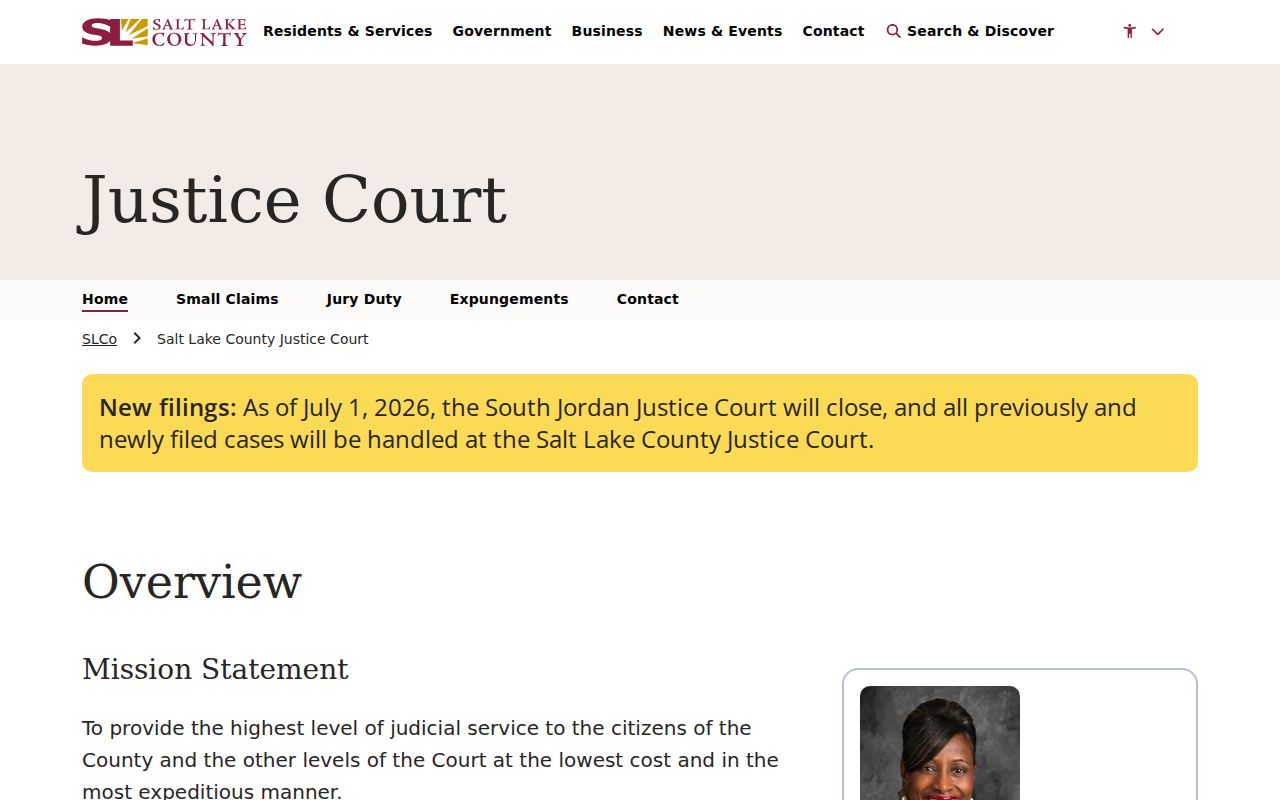
Use the public page to find the right Salt Lake County court contact, then ask that clerk to confirm a case-specific record. The page is general. It shows court information, not an individual warrant entry.
| Court | Common local case route | Contact |
|---|---|---|
| Third District Court | Felony and Class A misdemeanor matters | Criminal: 801-238-7321 |
| Salt Lake County Justice Court | County and transferred citation cases | 385-468-8200 |
| Salt Lake City Justice Court | City Class B/C cases and infractions | 801-535-6300 |
| West Valley, West Jordan/Taylorsville, Sandy | Separate city justice-court cases | Use the issuing court’s current page |
Salt Lake County Warrant Records: What They Show
BCI's training materials describe the data fields the statewide system uses. The public screen may show fewer. Court case access can add context, within record limits. Salt Lake County publishes no sample warrant number or universal bond amount to compare against, so treat any figure as case-specific.
| Name fields | BCI training lists name and other identifying data; public display may differ. |
|---|---|
| Warrant date | A system field, not necessarily the citation or case-filing date. |
| Offense or code | Confirm the court’s description rather than inferring a code. |
| Issuing court | Use this to find the clerk who controls case-level status. |
| Bond or release terms | Ask the court or jail; no countywide amount was located. |
| Recall or appearance | Confirm with the issuing court after payment or filing. |
Salt Lake County Search, Case History, and Jail Roster Are Different
BCI's statewide file answers a Salt Lake County warrant-search question. Utah Courts' XChange provides public case information. The Sheriff's Find a Prisoner page links to custody searches and jail rosters. None of them substitutes for another. A jail listing shows custody. It is not a warrant inventory, and XChange may omit sealed, expunged, juvenile, and other restricted records. Utah Courts explains XChange access and limits, and that page also describes the public courthouse terminals you can use for a status or identity match.
Salt Lake County Warrants: Who Issues, Who Serves
Judges and magistrates issue Salt Lake County warrants through the court process. The sheriff and local police handle service. The issuing court's clerk keeps the case record and explains its current instructions. Within the Sheriff's Law Enforcement Bureau, Warrants & Extraditions sits in the Investigation Division. No public roster or warrant-status line exists.
Third District Court
Matheson Courthouse, Salt Lake City
Criminal: 801-238-7321
Salt Lake County’s Warrants & Extraditions Unit Is Not a Public Roster
The Sheriff's Law Enforcement Bureau page lists Warrants & Extraditions as an Investigation Division function in Salt Lake County. It posts no individual warrants for browsing. The main Sheriff's site instead links the public to BCI, prisoner information, and records requests. A court case question goes to the issuing clerk. A county administrative record goes through the county's GRAMA request portal. Skip the Civil Process Unit for status questions. Its number is not a warrant-status desk. The Bureau's public hours run 8 to 5, so confirm current details on the official page before calling.
Handling a Salt Lake County Warrant
Start by confirming the court and the case number. Then ask the clerk which resolution path the order allows. Some matters end with a court appearance. Others need a payment, a motion, a bond, or a voluntary surrender. Salt Lake County Criminal Justice Services runs a Surrender Program that layers in screening, risk assessment, arraignment scheduling, court concurrence, and possible pretrial supervision, though eligibility and the result always depend on the case and the court.
Important: Speak with an attorney about a warrant and the safest way to appear; only the issuing court can confirm a recall or other case action.
The Salt Lake County Surrender Program Has Screening Steps
This Salt Lake County program is a named route, not an amnesty. Its first step is screening. A risk assessment follows. For an eligible case, staff may coordinate an arraignment and, with court approval, consider pretrial supervision. The program does not promise release. It does not promise any particular court outcome. The official page explains who may qualify and how to start. Read the Salt Lake County Surrender Program details before relying on an older instruction, and ask directly whether the program covers the warrant in question, keeping the court’s instructions with any appointment or filing.
A Salt Lake County Payment Is Not Always a Warrant Recall
A receipt proves a payment, not a recall. The transaction alone may not complete a required appearance or clear the warrant. Salt Lake County Justice Court payments stop after 4:30 p.m. The Metro Jail Visiting Lobby takes bail around the clock. That route is different from paying a court fine. The Sheriff’s bail page says visitors should use the silver-button operator instruction when the cashier window is closed. Ask the issuing court whether another step remains, and save the receipt or filing confirmation.
Warrant Record Access Under Utah Law
In Salt Lake County, GRAMA governs county administrative records. Judicial records answer to Utah court rules instead. Rule 4-202.02 sets the public and private categories. Arrest-warrant records are generally public, though a court may restrict them before service. Search warrants and affidavits open up after the Rule 40 unsealing point. Juvenile, sealed, expunged, personal, and protected enforcement information can stay restricted, and XChange is a public case tool, not a complete copy of every file.
Useful rules:
GRAMA, Utah Code Title 63G, Chapter 2, sets the state public-record framework.
Utah Court Rule 4-202.02, sorts court records into public and restricted classes.
Utah Rule of Criminal Procedure 40, governs search-warrant access and unsealing.
Salt Lake County’s Court Routes Changed in 2025 and 2026
Court routes across Salt Lake County have shifted. West Jordan and Taylorsville combined their court administration at 8040 S Redwood Road in November 2025, though each kept its own judges. South Jordan Justice Court closed permanently on July 1, 2026. Its cases moved to Salt Lake County Justice Court at 2001 S State Street, Suite S4-300. Old South Jordan listings are historical, not filing directions. Check the current court page before traveling, since a shared building does not make the city and case record interchangeable.
City Warrant Records in Salt Lake County
Salt Lake County holds several city justice courts. Each runs its own citation and case route. City police and court questions start at the local office. County and statewide records may need a separate warrant check. The five largest cities by the 2020 Census appear in population order, though those figures are historical Census counts, not current estimates. South Jordan cases now sit with the county court, since its city court closed.
Salt Lake City Warrants
199,723 residents, 2020 Census. City Justice Court handles city cases.
West Valley City Warrants
140,230 residents, 2020 Census. Check the city Justice Court and BCI.
West Jordan Warrants
116,961 residents, 2020 Census. Administration is shared with Taylorsville.
Sandy Warrants
96,904 residents, 2020 Census. The local court posts missed-date guidance.
South Jordan Warrants
77,487 residents, 2020 Census. Former court cases now route to the county.